
Preparations are in the final stages by the Chennai-headquartered space-tech startup Agnikul Cosmos for the maiden launch of India's first-ever private launchpad and the second rocket launch by a private sector player.
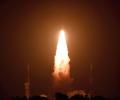
A S Kiran Kumar, chief of ISRO, said the mission was unsuccessful because the satellite housed within the heat sink could not be injected.

Countdown began on Thursday for the launch of the latest navigation satellite that will make India on par with the GPS of the US.

The Lagrange point 1 (L1) of the Sun-Earth system is about 1.5 million km from the Earth. It is about one per cent of the total distance between the Earth and the Sun.

In a textbook mission, ISRO's PSLV-C32 lifted off from Sriharikota and later injected the IRNSS-IF in sub-Geosynchronous Transfer Orbit.

In its first multi-orbital launch, India's workhorse PSLV will on Monday inject eight different satellites, including the country's weather satellite SCATSAT-1 and five from other nations, into two different orbits.
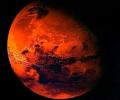
Crossing a major milestone in the country's space history, ISRO's Mars Orbiter mission ventured out of Earth's sphere of influence for the first time in an attempt to reach the red planet's orbit

Weighing 320 tonne at lift-off, the vehicle used larger strap-on motors to achieve higher payload capability.
A day after suffering a glitch during the fourth orbit raising operation on its Mars Orbiter Mission, the Indian Space Research Organisation on Tuesday successfully completed the supplementary manoeuvre, raising the spacecraft's apogee (farthest distance from Earth) to over 1,18,000 km.

This is ISRO's new record of launching 20 satellites, including those from the US, Germany, Canada and Indonesia.

The new ISRO chief talks bout the road ahead in his first interview after taking charge.
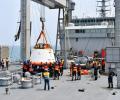
Nerves gave way to smiles at the spaceport in Sriharikota as delays and an anomaly-triggered 'hold' forced Indian Space Research Organisation (ISRO) scientists to revise the launch schedule of a test vehicle carrying payloads related to the country's ambitious human space flight mission, Gaganyaan which soared into skies after initial hiccups.

This is the first time ISRO was putting into orbit a two-tonne class satellite.\n\n
ISRO sources said that with Sunday's mission, the agency has launched 62 satellites, one space recovery module and 37 rockets, making it a grand 100

The Trans-Lagrangian Point 1 Insertion manoeuvre marks the beginning of the spacecraft's about 110-day trajectory to the destination around the L1 Lagrange point, a balanced gravitational location between the Earth and the Sun.
The Indian Space Research Organisation's Satish Dhawan Space Centre in Sriharikota will soon initiate the process of creating Third Launch Pad for human transportation into space, SHRC Director Chandra Datttan on Tuesday said during Republic Day celebrations.
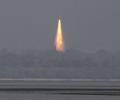
Enthused over its successful launch of GSLV D5 with GSAT-14 communication satellite from Satish Dhawan Space Centre in Sriharikota on Sunday, the Indian Space Research Organisation is planning a series of GSLV launches and an experimental launch of the advanced version GSLV Mark III soon from the spaceport.

The heaviest rocket of the Indian Space Research Organisation -- LVM3-M2/OneWeb India-1 -- blasted off from the Sriharikota spaceport on Sunday to place 36 broadband communication satellites into the Low Earth Orbit (LEO) for a UK-based customer.

"We started it by 1.17 am and have successfully completed the first orbit raising manoeuvre of Mars Orbiter Spacecraft. Right now, the computation is going on," an ISRO spokesman told PTI.

As more than 400 candidates from a single state -- Haryana -- had taken the test, there are suspicions over whether coaching centres may be involved.
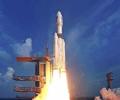
Taking its baby steps towards realising India's ambition to send humans into space, Indian Space Research Organisation on Thursday successfully tested the atmospheric re-entry of a crew module after its heaviest launch vehicle GSLV MK III blasted off from Sriharkota.

Chandrayaan 3 follows the Chandrayaan 2 mission which did not achieve the desired soft landing on the surface of the moon in 2019, disappointing the scientists.
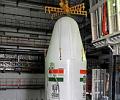
The launch of a Geosynchronous Satellite Launch Vehicle was called off by the Indian Space Reasearch Organisation at the eleventh hour on Monday due to a fuel leak in its second stage -- in a setback to the mission to test its homegrown cryogenic engine -- after its failure three years ago.

After having successfully completed three orbit raising manoeuvres, ISRO's Mars Orbiter mission on Monday suffered a glitch as it failed to achieve the targeted apogee (farthest distance from Earth) of one lakh km during the fourth orbit raising operation in the early hours.

NavIC consists of a constellation of seven satellites and a network of ground stations and is touted to be more accurate than GPS.

'What we have done is a symbol of new India; that is what a small start-up can do, a few hundreds of people coming together, developing a rocket and launching to space and succeeding at the very first attempt.'

The polar satellite launch vehicle's 52nd mission is scheduled for lift-off at 15.41 hours on Thursday from the second launch pad at the spaceport of Sriharikota 'subject to weather conditions'.

The GSAT-31 is a 'high power' communication satellite going to serve and replace some of the satellites that are going to expire soon.

'You declare a date, time and place for the landing two months in advance and exactly at that moment, it touched on the moon.'

In the first dedicated mission of its commercial arm New Space India Limited (NSIL), the Indian Space Research Organisation on Sunday successfully launched Brazil's earth observation satellite Amazonia-1 and 18 other co-passengers, including five built by students, onboard a Polar rocket from the spaceport in Sriharikota.
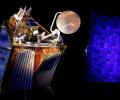
Bharti group-backed OneWeb and New Space India Limited, the commercial arm of the Indian Space Research Organisation, have entered into an agreement that will help ensure OneWeb completes its satellite launch programme. The first launch with New Space India is expected in 2022 from the Satish Dhawan Space Centre (SDSC) SHAR, Sriharikota. The launches will add to Low Earth Orbit (LEO) satellite communications firm OneWeb's total in-orbit constellation of 428 satellites -- 66 per cent of the planned total fleet -- to build a global network that will deliver high-speed, low-latency connectivity.

During the day-long debate, the lines between science and religion often got blurred with many invoking religious texts and the contribution of 'rishi munis' to highlight India's tryst with the extra-terrestrial world.

The 6-metre tall launch vehicle Vikram-S is named after Vikram Sarabhai, the father of the country's space programme and lifted off at 11.30 am.

'The current launch is a sounding rocket, this cannot be called a milestone. The importance is this is for the first time a private player is doing it.'

Thursday's launch is the last one of 2020 for ISRO.

I suggest we build a Vigyan Mandir (Temple of Science) with the ambience of a place of worship, so that it becomes a destination for pilgrims. We should embed on its walls bronze plaques describing each scientist mentioned here along with about a dozen of our ancient mathematicians, recommends Professor Kalyan Singhal, historian of science and technology.
Launch of India's latest communication satellite GSAT-5P onboard homegrown GSLV-F06, powered by Russian cryogenic engine, failed on Saturday when the rocket developed a snag soon after lift-off from the spaceport in Sriharikota.

'Today, when we talk of success of PSLV and GSLV Mk III, we owe it to important inputs that the Prof. Narasimha committee gave'

CARTOSAT-3 is a third generation agile advanced satellite having high resolution imaging capability.
The 51-hour countdown for India's landmark 100th space mission began on Friday with Indian Space Research Organisation's old warhorse Polar Satellite Launch Vehicle rocket all set to soar into space on September 9 with two foreign satellites from the spaceport of Sriharikota in Andhra Pradesh.
